
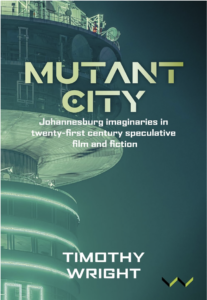
 Mutant City addresses the profusion of speculative and experimental fictions anchored in twenty-first century Johannesburg: fantasy, urban noir, sci-fi, comic books, and more. It uses these texts as inroads into the complex psychosocial imaginaries – around national transformation, race, entanglement, inequality, and environmental crisis – that have attached themselves to this difficult and fascinating city, once the epicentre of apartheid spatial planning, now an unruly African megacity. At the centre of the book is the question of what transformation might mean in an era when South Africa’s post-apartheid transition appears to have stalled. The book reads these texts through the lens of what I broadly (and playfully) term mutancy. While transition suggests a linear movement from state a to state b, mutation describes a variety of discontinuous, experimental transformations that emerge from the material world of the city itself, and that succeed or fail on the city’s terms. Drawing out Johannesburg’s mutancy – its capacity to house and induce unexpected transformations – the book illuminates the logics that have sprouted up in the shadows of South Africa’s official story of transition, sometimes in tandem with it, more often in argument. In the process, the book explores how Johannesburg’s peculiar urban conditions have reshaped inherited genres, generating a distinctive speculative aesthetics that renders the seemingly mundane and defunct strange and unpredictable. Ultimately, the book asks how Johannesburg might inform the imagining of futures – be they catastrophic or regenerative, whether they suggest mere survival or forms of becoming – as the guiding rails of an older ‘allegory of emancipationist redemption’ (David Scott’s phrase) fall away.